
Scanning Services in Kuwait: Complete Guide to Document Digitization and Electronic Archiving
Document Scanning Services | خدمات المسح الضوئي و الارشفة الالكترونية
Businesses and government institutions across Kuwait are rapidly shifting from paper-based archives to secure digital document management systems. Scanning services in Kuwait have become essential for organizations that manage large volumes of physical files, contracts, invoices, medical records, engineering drawings, and legal documentation.
As regulatory requirements increase and operational efficiency becomes a priority, document digitization is no longer optional. Companies that rely on paper archives face rising storage costs, retrieval delays, compliance risks, and limited scalability. Professional document scanning services in Kuwait provide a structured pathway toward digital transformation, operational control, and long-term information security.
This guide explains everything organizations need to know about document scanning, electronic archiving, OCR processing, and secure data management in Kuwait.
Why Scanning Services in Kuwait Are in High Demand
Several factors are driving the demand for document scanning and digitization services in Kuwait:
1. Regulatory Compliance Requirements
Government entities, financial institutions, healthcare providers, and oil & gas companies must maintain accurate records for extended periods. Digital archives make compliance monitoring, audits, and reporting significantly easier.
2. Rising Real Estate and Storage Costs
Physical document storage consumes valuable office space. Warehouses, filing cabinets, and archive rooms generate long-term expenses. Digitization reduces physical storage needs dramatically.
3. Operational Efficiency
Paper-based systems slow down workflow. Retrieving a document may take minutes or hours. A searchable digital archive provides instant access within seconds.
4. Business Continuity and Risk Management
Paper records are vulnerable to:
- Fire damage
- Water leaks
- Misplacement
- Unauthorized access
Digital archives with secure backups protect critical business information.
What Are Professional Scanning Services?
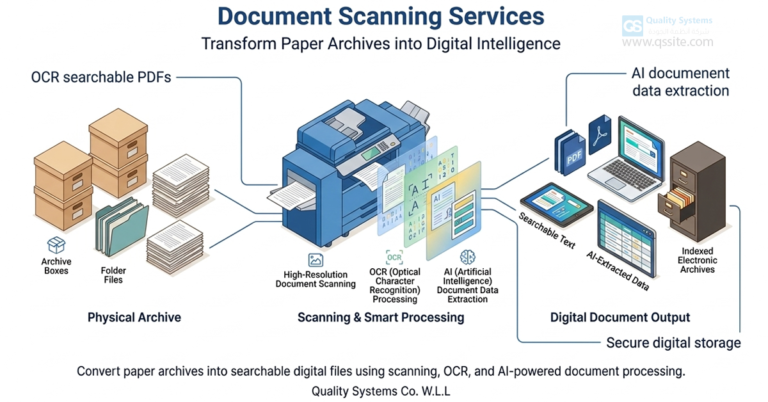
Scanning services in Kuwait involve converting physical documents into high-quality digital files using specialized equipment and structured indexing processes.
The process includes:
- Document preparation
- High-speed scanning
- Image enhancement
- Optical Character Recognition (OCR)
- Indexing and classification
- Secure digital storage
The result is a searchable, organized, and secure electronic archive.
Types of Documents Commonly Digitized in Kuwait
Organizations across multiple industries require document digitization. The most commonly scanned materials include:
Corporate Documents
- Contracts and agreements
- HR records
- Corporate governance files
- Board meeting minutes
Financial Documents
- Invoices
- Purchase orders
- Bank statements
- Audit reports
Healthcare Records
- Patient files
- Laboratory reports
- Consent forms
Engineering and Construction Files
- Blueprints
- Technical drawings
- Project documentation
Legal Documentation
- Case files
- Court records
- Compliance documents
Each document category requires specific handling standards and indexing rules.
The Complete Document Scanning Process
Step 1: Archive Assessment
A professional scanning company in Kuwait begins by evaluating:
- Total volume of documents
- Document types
- Page sizes
- Document condition
- Retention policies
This assessment determines equipment requirements and project timelines.
Step 2: Document Preparation
Before scanning, documents are:
- Sorted
- Staples removed
- Organized by category
- Labeled for indexing
Proper preparation ensures clean scanning and accurate data capture.
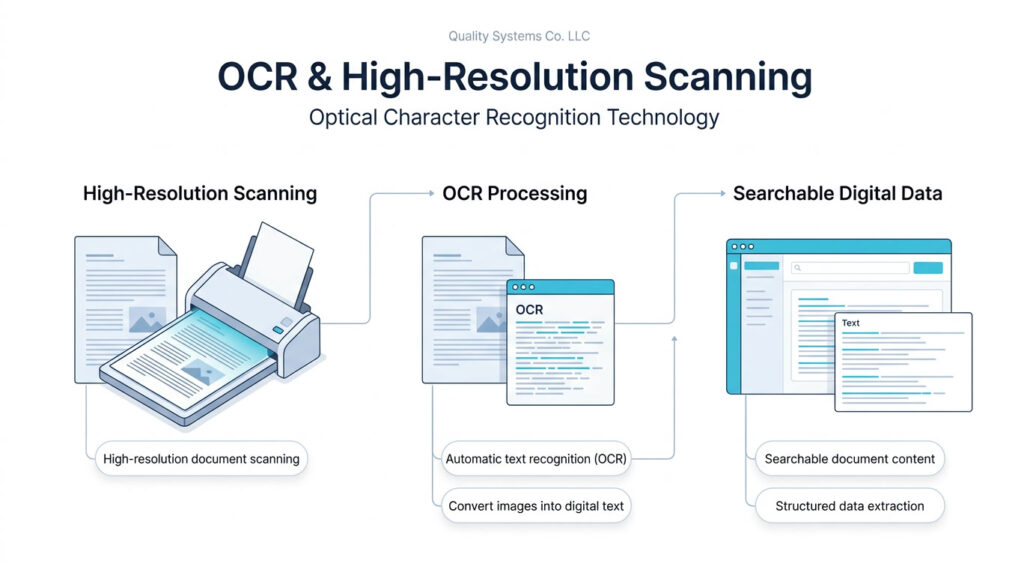
Step 3: High-Resolution Scanning
Industrial-grade scanners capture documents at optimized resolutions depending on content type. For text documents, standard DPI settings are used. For engineering drawings or medical reports, higher resolutions may be required.
Step 4: Image Processing and Quality Control
Technicians review each batch to:
- Remove skew
- Adjust brightness
- Correct orientation
- Ensure clarity
Quality control ensures readable, compliant digital files.
Step 5: OCR (Optical Character Recognition)
OCR technology converts scanned images into searchable text. This enables:
- Keyword search
- Data extraction
- Text copying
- Automated indexing
Searchable PDFs significantly increase document usability.
Step 6: Indexing and Classification
Indexing is one of the most critical phases. Files are categorized using metadata such as:
- Document number
- Date
- Department
- Client name
- Project reference
Accurate indexing ensures long-term archive efficiency.
Step 7: Secure Storage and Delivery
Files are delivered through:
- Secure cloud storage
- On-premise document management systems
- Encrypted external drives
- Enterprise archiving platforms
Data security is maintained throughout the process.
Benefits of Professional Document Scanning in Kuwait
1. Improved Accessibility
Employees can retrieve documents instantly through search functionality, eliminating manual file handling.
2. Reduced Operational Costs
Digital storage significantly lowers costs related to:
- Physical storage
- Archive management staff
- Paper and printing
3. Enhanced Data Security
Digital archives allow:
- Role-based access control
- Activity logging
- Encryption
- Backup redundancy
4. Faster Business Processes
Digitization accelerates:
- Invoice approvals
- Contract reviews
- Compliance audits
- Internal reporting
5. Environmental Sustainability
Reducing paper usage supports corporate sustainability initiatives.
Scanning Services for Key Industries in Kuwait
Oil and Gas Sector
Oil companies manage extensive documentation including engineering plans, compliance reports, and safety records. Digitization ensures secure and structured archive management.
Banking and Financial Institutions
Financial institutions require secure document management to maintain customer records, regulatory compliance, and transaction documentation.
Healthcare Sector
Hospitals and clinics benefit from searchable patient files and secure digital record management.
Government Entities
Government departments rely on structured digital archives for policy documentation, licensing records, and public service administration.
Data Security and Confidentiality Standards
Organizations in Kuwait prioritize confidentiality when outsourcing scanning services.
A professional provider should offer:
- Confidentiality agreements
- Controlled access facilities
- Background-checked staff
- Encrypted data handling
- Secure transportation of documents
Data protection is critical, especially in regulated sectors.
OCR and Data Extraction Capabilities
Beyond simple scanning, advanced scanning services include:
- Automated data capture
- Invoice data extraction
- Structured indexing
- Keyword tagging
- Multi-language recognition (Arabic and English)
This transforms static documents into actionable data.
Choosing the Right Scanning Company in Kuwait
When selecting a document scanning service provider, evaluate:
Experience
Years of experience in enterprise document digitization.
Technology
Use of high-speed industrial scanners and reliable OCR systems.
Security Infrastructure
Clear data protection and confidentiality procedures.
Scalability
Ability to handle large archives, including millions of pages.
Customization
Flexible indexing structures tailored to business requirements.
Cost of Scanning Services in Kuwait
The cost of document scanning varies based on:
- Volume of documents
- Document condition
- Required indexing complexity
- OCR requirements
- On-site vs off-site scanning
Large-scale projects typically benefit from phased implementation plans.
On-Site vs Off-Site Scanning
On-Site Scanning
Advantages:
- Documents remain within premises
- Ideal for sensitive records
Off-Site Scanning
Advantages:
- Faster processing
- Lower operational disruption
- Access to industrial equipment
Organizations choose based on security and logistics needs.
Common Challenges in Digitization Projects
- Mixed document sizes
- Damaged or old records
- Duplicate files
- Poor document organization
An experienced scanning provider addresses these challenges through structured workflows.
Long-Term Value of Electronic Archiving
Digitized archives enable:
- Analytics and reporting
- Faster audits
- Seamless digital transformation
- Integration with ERP and document management systems
Electronic archiving supports sustainable organizational growth.
Frequently Asked Questions
How long does a scanning project take?
Project duration depends on document volume and complexity. Large archives may require phased execution.
Can millions of pages be digitized?
Yes, industrial scanning equipment supports large-scale digitization projects.
Are scanned documents legally valid?
Digital copies are widely accepted when handled according to compliance standards.
Is OCR accurate for Arabic documents?
Modern OCR solutions support both Arabic and English with high accuracy when documents are properly scanned.
Conclusion
Scanning services in Kuwait are essential for organizations seeking operational efficiency, regulatory compliance, and long-term information security. Professional document digitization transforms paper archives into searchable, structured, and secure digital systems.
Whether serving government entities, financial institutions, healthcare providers, or corporate enterprises, document scanning services provide measurable operational and strategic value.
Companies that invest in electronic archiving today build the foundation for scalable, secure, and data-driven operations tomorrow.