
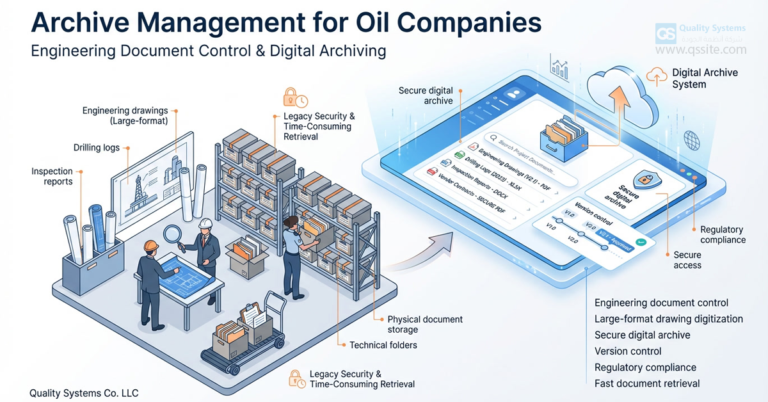
Oil and gas companies operate in one of the most documentation-intensive industries in the world. From exploration reports and drilling logs to engineering drawings, compliance documentation, and vendor contracts, the volume of records generated across upstream, midstream, and downstream operations is immense.
Archive management for oil companies is not simply an administrative function. It is a critical operational and compliance pillar that directly impacts safety, regulatory adherence, project execution, and financial accountability. Poor document control can delay projects, expose organizations to legal risks, and compromise operational continuity.
This guide provides a complete overview of archive management in oil companies, including document digitization, engineering document control, regulatory compliance, security standards, and long-term digital archiving strategies.
Why Archive Management Is Critical in Oil and Gas Companies
Oil companies operate under strict regulatory frameworks and complex project environments. Archive management plays a central role in:
- Regulatory compliance
- Safety documentation
- Engineering change management
- Contract administration
- Environmental reporting
- Asset lifecycle management
The scale and complexity of documentation in oil and gas operations require structured archive systems rather than basic file storage.

Types of Documents Managed by Oil Companies
Archive management in oil companies covers multiple categories of documentation:
Engineering and Technical Documents
- P&ID diagrams
- Structural drawings
- As-built drawings
- Equipment datasheets
- Maintenance manuals
- Inspection reports
Exploration and Drilling Records
- Geological surveys
- Seismic data reports
- Drilling logs
- Well completion reports
Regulatory and Compliance Documentation
- Environmental impact assessments
- Safety audit reports
- Incident investigations
- Government correspondence
Procurement and Contract Documents
- Vendor contracts
- Purchase orders
- Tender documentation
- Project agreements
Financial and Audit Records
- Cost reports
- Project budgets
- Internal audit documentation
Each category requires defined retention schedules, access controls, and version tracking.
Challenges in Archive Management for Oil Companies
Large Volume of Engineering Drawings
Engineering projects generate thousands of revisions. Without structured document control, outdated drawings may circulate, increasing operational risks.
Multi-Site Operations
Oil companies operate across offshore rigs, refineries, pipelines, and corporate offices. Centralized archive access becomes essential.
Regulatory Audits
Government authorities require complete and traceable documentation. Missing records can result in penalties.
Long Retention Periods
Some oil and gas records must be retained for decades due to legal and environmental obligations.
Paper-Based Legacy Archives
Many oil companies maintain historical project archives in physical storage, limiting accessibility and increasing risk.
What Is Archive Management in the Oil and Gas Industry?
Archive management for oil companies involves structured processes for:
- Document classification
- Version control
- Secure storage
- Digitization
- Access management
- Retention and disposal policies
Modern archive management combines physical document control with digital document management systems (DMS).
Document Digitization for Oil Companies
Digitization plays a central role in modern archive management.
Scanning Engineering Drawings
Large-format scanners capture:
- A0 engineering drawings
- Technical schematics
- Plant layout diagrams
High-resolution scanning preserves detail and readability.
OCR for Technical Documentation
Optical Character Recognition enables searchable access to:
- Inspection reports
- Maintenance logs
- Compliance forms
Searchable archives significantly improve retrieval speed.
Structured Metadata Indexing
Metadata fields typically include:
- Project name
- Asset ID
- Document number
- Revision number
- Department
- Approval status
Proper indexing prevents document duplication and confusion.
Electronic Document Management Systems in Oil Companies
Digitized archives are typically stored within document management systems that provide:
- Version control
- Access permissions
- Audit trails
- Document workflows
- Approval tracking
Version control is especially critical in engineering environments where multiple revisions occur.
Compliance and Regulatory Requirements in Oil & Gas
Oil companies must comply with:
- Environmental regulations
- Occupational health and safety standards
- Government licensing authorities
- International operational standards
Archive management systems ensure:
- Traceability
- Controlled retention
- Document authenticity
- Access logging
Audit-ready documentation reduces compliance risks.
Secure Archive Management for Sensitive Energy Data
Security is paramount in the oil and gas industry.
Archive management systems must support:
- Role-based access control
- Multi-factor authentication
- Encryption at rest and in transit
- Activity monitoring
- Backup redundancy
Engineering documents and strategic reports require strict access governance.
Centralized vs Decentralized Archive Models
Centralized Archive Management
Advantages:
- Unified document control
- Standardized indexing
- Improved compliance tracking
Decentralized Archive Management
Advantages:
- Department-level autonomy
- Faster localized processing
Most oil companies adopt hybrid models with centralized digital repositories.
On-Site vs Off-Site Archive Digitization
On-Site Digitization
- Suitable for highly confidential documents
- Maintains physical control within facilities
Off-Site Digitization
- Enables high-volume processing
- Access to industrial scanning equipment
- Faster project execution
The choice depends on document sensitivity and operational requirements.
Benefits of Modern Archive Management for Oil Companies
Improved Project Efficiency
Engineers and project managers can retrieve technical documentation instantly.
Reduced Risk of Using Outdated Drawings
Version control systems ensure that only the latest approved documents are used in operations.
Enhanced Regulatory Compliance
Structured archives simplify inspections and audits.
Cost Optimization
Digital storage reduces warehouse and physical archive management expenses.
Business Continuity
Digital backups protect vital records against disasters.
Archive Retention Policies in Oil Companies
Oil companies must define retention policies based on:
- Regulatory mandates
- Environmental requirements
- Contractual obligations
- Internal governance standards
Archive management systems automate retention scheduling and controlled disposal.
Integration with ERP and Asset Management Systems
Archive management for oil companies often integrates with:
- Enterprise Resource Planning (ERP) systems
- Asset management platforms
- Maintenance management systems
- Procurement systems
Integration ensures seamless information flow across departments.
Common Mistakes in Oil Company Archive Management
- Lack of document version control
- Inconsistent indexing standards
- Poor metadata classification
- Delayed digitization of legacy archives
- Inadequate backup procedures
Avoiding these mistakes requires structured governance and professional archive solutions.
Cost Considerations for Archive Management Projects
Costs depend on:
- Archive size
- Complexity of indexing
- Digitization requirements
- Integration scope
- Security infrastructure
Large-scale oil companies often implement phased archive modernization.
Long-Term Strategic Value
Archive management is not merely operational housekeeping. In oil companies, it directly supports:
- Asset lifecycle management
- Environmental accountability
- Engineering reliability
- Legal defense readiness
- Corporate governance
Structured archives become strategic information assets.
Frequently Asked Questions
How long must oil companies retain technical records?
Retention periods vary by jurisdiction and document type, often extending for decades.
Can large-format engineering drawings be digitized?
Yes, industrial large-format scanners capture detailed technical drawings accurately.
Is digital archiving secure for sensitive energy data?
With proper encryption, access control, and monitoring, digital archives can exceed physical security standards.
Can historical project archives be digitized?
Yes, legacy archives can be digitized through phased implementation strategies.
Conclusion
Archive management for oil companies is a foundational component of operational integrity, regulatory compliance, and engineering reliability. The oil and gas sector generates complex, high-volume documentation that requires structured control, secure storage, and efficient retrieval systems.
Modern digital archive management solutions transform traditional paper-based storage into secure, searchable, and compliant electronic repositories. Oil companies that invest in professional archive management gain operational efficiency, risk reduction, and long-term strategic value.
As energy operations grow more complex and compliance standards tighten, structured archive management is no longer optional. It is a critical infrastructure layer supporting safe, compliant, and efficient oil and gas operations.